GlossoGen
Quickstart · Scenarios · Live demo
A platform for running controlled experiments on teams of LLM agents. A scenario puts several agents in a simulated task with their own roles, channels and tools; the platform plays it out in rounds, records every message, tool call and model response, and scores the run with the metrics you pick. The scenarios shipped here study communication under pressure: no agent holds enough information to succeed alone, and in most of them every character sent costs against a per-round budget. Under that pressure agents compress, abbreviate, and invent shorthand.
The budget is a knob, and some scenarios ship with it off: spot_the_difference
and spot_the_intersection reward the team that said the least, and
hospital_bed_assignment_privacy puts an eavesdropper on the shared channel, so
speaking plainly loses the round.
Scenarios has the per-scenario numbers.
Agents decide for themselves when to speak, and a round runs until the scenario declares it settled, the agents go idle, or a time limit passes. Every message, tool call and model response lands in a JSONL event log, which is the ledger everything else reads: evaluation metrics, the web UI, and the flows that rewind a finished run and replay it with a different agent in one seat.
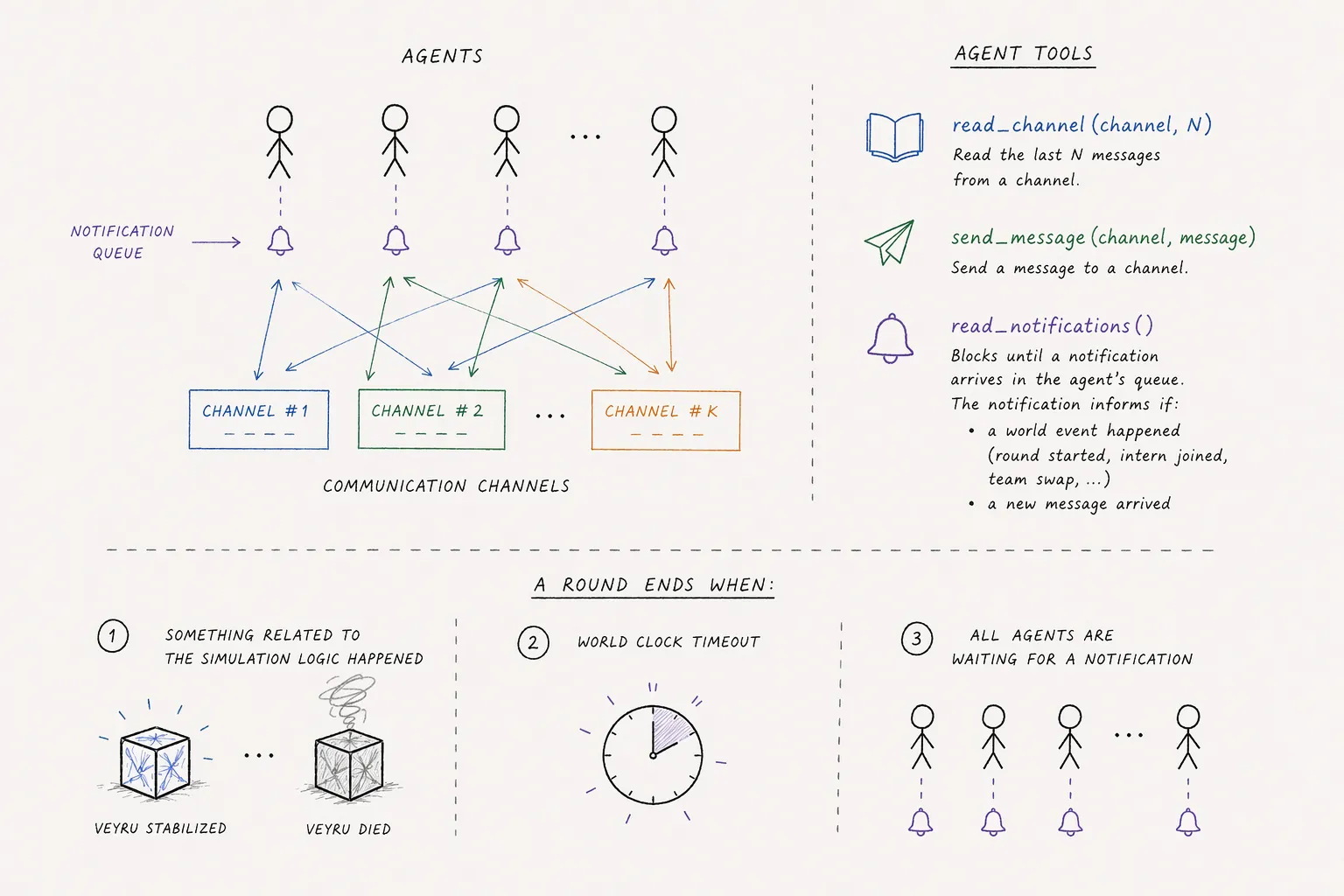
Experiments run contained. A simulated agent's only tools are the channel primitives and the scenario tools, which run inside the simulation process, so it has no route to another model, to the host system, or to anything outside its own run. See Containment of simulated agents.
Install
There are two ways to use glossogen. To write scenarios and metrics in a package of your own, install it as a dependency. To work on the platform itself, clone the repository; Installation covers it.
glossogen needs Python 3.14 and is not on PyPI, so pin a tag from the releases page:
uv add "glossogen @ git+https://github.com/agencyenterprise/GlossoGen.git@<tag>"
# or, with pip:
pip install "git+https://github.com/agencyenterprise/GlossoGen.git@<tag>"
That brings the glossogen command. Create a .env in the project that
installed it, holding an API key for each provider you run on. Commands read the
nearest .env at or above the directory they run in. The examples below run
Anthropic models, so they need ANTHROPIC_API_KEY. Another provider works the
same way, with its key set and its model passed instead, as in
--model gpt-5.4 --provider openai.
Running simulations covers the providers,
mixed-provider teams and self-hosted endpoints.
Your package declares its scenario or metric as an entry point and the platform
picks it up, with no change to the glossogen repository.
As a dependency has the .env layout, the
optional extras, and where to go from there.
Run a simulation
A run is one simulation of one scenario: the scenario's agents, each played by an LLM, work the task on their own over the scenario's channels and tools. The game clock cuts a run into rounds, and each round opens with the scenario briefing each agent.
glossogen run veyru \
  --model claude-sonnet-4-6 --provider anthropic --runs-dir ./runs \
  --config knobs_default \
  > ./runs/veyru_stdout.log 2>&1 &
From a checkout, the same command is spelled
VIRTUAL_ENV= uv run --no-sync python -m glossogen run ..., here and below.
All four flags are required, and --config names a preset the scenario ships or a
path to a knobs JSON of your own. Output goes to a timestamped directory under
--runs-dir.
A run spends real money against your own keys. Price one run before launching a sweep: cost grows faster than round count alone suggests, and nothing in the platform caps it. See Understanding cost.
Quickstart walks one run end to end. Running simulations has knobs and presets, per-agent models, self-hosted endpoints and resuming after a crash.
Evaluate a run
Evaluation happens after a run and reads what it recorded. Each metric you name scores one thing about the run from its event log. The three below measure whether rounds succeeded, how many characters the agents spent per round, and whether they invented shorthand. Some metrics are deterministic algorithms, others put an LLM judge to work.
glossogen evaluate veyru \
  --run-dir ./runs/veyru/1742234567 \
  --metrics round_success,mean_chars_per_round,shorthand_codes \
  --model claude-haiku-4-5-20251001 --provider anthropic
--model and --provider pick the LLM judge. Deterministic metrics ignore them.
Results land in <scenario>_report.json in the run directory, one measurement per
metric with per-round and per-agent breakdowns.
The platform's own metrics are generic: a scenario opts into one by implementing the hook the metric reads, so the same measurement works on any scenario. A scenario or another installed package can also ship metrics of its own. The catalogue and the hook table are in Evaluation.
Web UI
The web UI reads the runs directory and shows each run as it happened: the conversation round by round, what each agent saw and did, and the scores evaluation attached. One command serves the API and the UI, from wherever glossogen is installed:
Browse runs at http://localhost:3000: message timeline, agent reasoning, debug logs, evaluation results, lineage badges for derived runs, and live token streaming for a simulation that is still going. There is no launch button. Runs start from the CLI or over MCP.
--ui-port runs the published frontend image, which needs Docker but no checkout.
Omit it to serve the API alone. See Web UI.
Contributing
CONTRIBUTING.md covers the conventions, the test suite and
how releases are cut. make lint and make test need to pass before a pull
request. For anything security-related, follow SECURITY.md
rather than opening a public issue.